Introductory Readings In Ancient Greek And Roman Philosophy Pdf Download
Ancient Roman philosophy was heavily influenced by the aboriginal Greeks and the schools of Hellenistic philosophy; all the same, unique developments in philosophical schools of thought occurred during the Roman period as well. Interest in philosophy was offset excited at Rome in 155 BC, by an Athenian diplomatic mission consisting of the Academic skeptic Carneades, the Stoic Diogenes of Babylon, and the Peripatetic Critolaus.[ane]
During this fourth dimension Athens declined as an intellectual center of thought while new sites such equally Alexandria and Rome hosted a diversity of philosophical word.[2]
Both leading schools of law of the Roman menstruum, the Sabinian and the Proculean Schools, drew their ethical views from readings on the Stoics and Epicureans respectively,[three] assuasive for the competition between thought to manifest in a new field in Rome's jurisprudence. It was during this period that a common tradition of the western philosophical literature was born in commenting on the works of Aristotle.[2]
Characteristics [edit]
Roman philosophy includes not only philosophy written in Latin, simply also philosophy written in Greek by Roman citizens. Important early Latin-linguistic communication writers include Lucretius, Cicero, and Seneca the Younger. Greek, was the more popular language for writing about philosophy, and then much so that the Roman Emperor Marcus Aurelius chose to write his Meditations in Greek. Later, with the spread of Christianity inside the Roman Empire, came the Christian philosophy of Saint Augustine of Hippo. One of the last philosophical writers of antiquity was Boethius, whose writings are the chief source of information as to Greek philosophy during the first centuries of the Middle Ages.[1]
While philosophers are usually categorized according to school, some philosophers of the Roman period held eclectic beliefs, taking teachings from more than than one schoolhouse. The Sabinian and Proculean schools of law, the two largest schools of legal thought in the Roman period, derived their understanding of ethics heavily from Stoicism and Epicureanism respectively, once more providing a current for philosophical idea to influence life in the Roman menstruum.
History [edit]
While philosophy was ofttimes admired by jurists and aristocrats, of the emperors the analogousness that Hadrian held for philosophy stands out, a feature that was probable amplified by his philhellenism. Hadrian was recorded to take attended lectures by Epictetus and Favorinus on his tours of Greece, and invested heavily in attempting to revive Athens as a cultural centre in the aboriginal world through methods of primal planning on his part.[iv] Hadrian held philosophy in high regard, something unusual for Roman emperors, who were oftentimes indifferent, if not oppositional to it as a exercise. These sentiments in favor of philosophy were likewise shared by the emperors Nero, Julian the Backslider, and Marcus Aurelius – the latter two of which are at present considered as philosophers.
During the autocratic rule of the Flavian dynasty, a group of philosophers vocally and politically protested against imperial actions, particularly under Domitian and Vespasian. This resulted in Vespasian banishing all philosophers from Rome, salvage for Gaius Musonius Rufus; although he, too, was afterwards banished.[5] This consequence later became known as the Stoic Opposition, as a majority of the protesting philosophers were Stoics. Later on in the Roman catamenia, Stoics came to regard this opposition highly; nonetheless, the term "Stoic Opposition" was non coined until the 19th century, where it first appears in the writings of Gaston Boissier.[half dozen]
Schools of thought [edit]
Academic skeptic
- Cicero (106 – 43 BC)
- Favorinus (c. 80 – c. 160 AD)
Christian
- Clement of Alexandria (150 – 215 Advertising)
- Augustine of Hippo (354 – 430 AD)
Cynicism – Cynic philosophy survived into the Imperial period, and even became "stylish", though its adherents were criticized for non being fully committed.[7]
- Demetrius the Carper
Epicurean
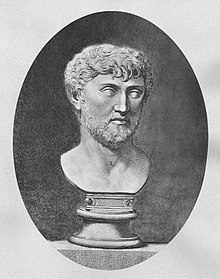
- Zeno of Sidon (150–75 BC)
- Alcaeus and Philiscus (150 BC)
- Phaedrus (138–70 BC)
- Gaius Amafinius (125 BC)
- Titus Pomponius Atticus (110 BC–33 BC)
- Philodemus (110–l BC)
- Titus Albucius (105 BC)
- Rabirius (100 BC)
- Patro (seventy BC)
- Siro (l BC)
- Catius (50 BC)
- Lucretius (94–55 BC)
Platonic
- Alcinous (philosopher) (second century Advertisement)
Neoplatonist
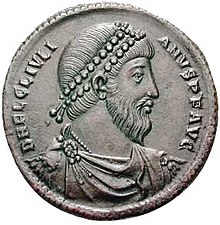
- Plotinus (205 – 278AD)
- Amelius Gentilianus (3nd century Advertisement)
- Porphyry (232 – 304 Ad)
- Julian (331 – 363 AD)
- Iamblichus (242 – 327 AD)
- Damascius (462 – 540 Ad)
- Simplicius of Cilicia (490 – 560 AD)
- Boethius (472 – 524 Advertisement)
Neopythagorean
- Quintus Sextius the Elder (40 BC)
- Sotion (~1st century Advertisement)
- Nigidius Figulus (98 BC - 45)
- Secundus the Silent (second century AD)
- Iamblichus (245 AD - 325)
Peripatetic
- Alexander of Aphrodisias (3rd century AD)
Pyrrhonist
- Theodas of Laodicea (2nd century AD)
- Menodotus of Nicomedia (2nd century AD)
- Sextus Empiricus (second century AD)
Sextii
- Sotion (Pythagorean) (200 – 170 BC)
- Papirius Fabianus (1st century Ad)
- Crassicius Pasicles (?)
Stoic

- Publius Rutillius Rufus (158–75 BC)
- Lucius Aelius Stilo Praeconinus (154–74 BC)
- Diodotus the Stoic (130–59 BC)
- Marcus Vigellius (125 BC)
- Quintus Lucilius Balbus (125 BC)
- Antipater of Tyre (100–45BC)
- Cato the Younger (95–46 BC)
- Porcia Catonis (seventy–43 BC)
- Apollonides (46 BC)
- Quintus Sextius the Elder (40 BC)
- Seneca the Younger (4 BC – 65 Advertising)
- Attalus (25 Ad)
- Papirius Fabianus (30 AD)
- Musonius Rufus (30–100 AD)
- Epictetus (55–135 Advertising)
- Marcus Aurelius (121–180 Ad)
Notes [edit]
- ^ a b "Roman Philosophy | Net Encyclopedia of Philosophy".
- ^ a b Annas, Julia. (2000). Voices of Aboriginal Philosophy: An Introductory Reader. Oxford Academy Press. ISBN978-0-19-512694-5. OCLC 870243656.
- ^ Lorenzen, Ernest Chiliad. (1925). "Specification in the Ceremonious Law". The Yale Law Journal. 35 (1): 29–47. doi:10.2307/789534. ISSN 0044-0094. JSTOR 789534.
- ^ Lane Flim-flam, Robin, 1946- (2006). The classical world : an epic history from Homer to Hadrian. New York: Basic Books. ISBN0-465-02496-3. OCLC 70149306.
{{cite book}}: CS1 maint: multiple names: authors list (link) - ^ Flavian Rome : culture, epitome, text. Boyle, A. J. (Anthony James),, Dominik, William J. Leiden. 2003. ISBN90-04-11188-3. OCLC 51061501.
{{cite volume}}: CS1 maint: others (link) - ^ J. P. Sullivan (October 1986). "Literature and Politics in the Age of Nero. Ithaca: Cornell Academy Press. 1985". The American Historical Review. doi:ten.1086/ahr/91.4.893. ISSN 1937-5239.
- ^ Adamson, Peter (2015). Philosophy in the Hellenistic and Roman Worlds. Oxford University Press. p. 16. ISBN978-0-19-872802-three.
DOWNLOAD HERE
Posted by: ferriexames.blogspot.com


0 Comments